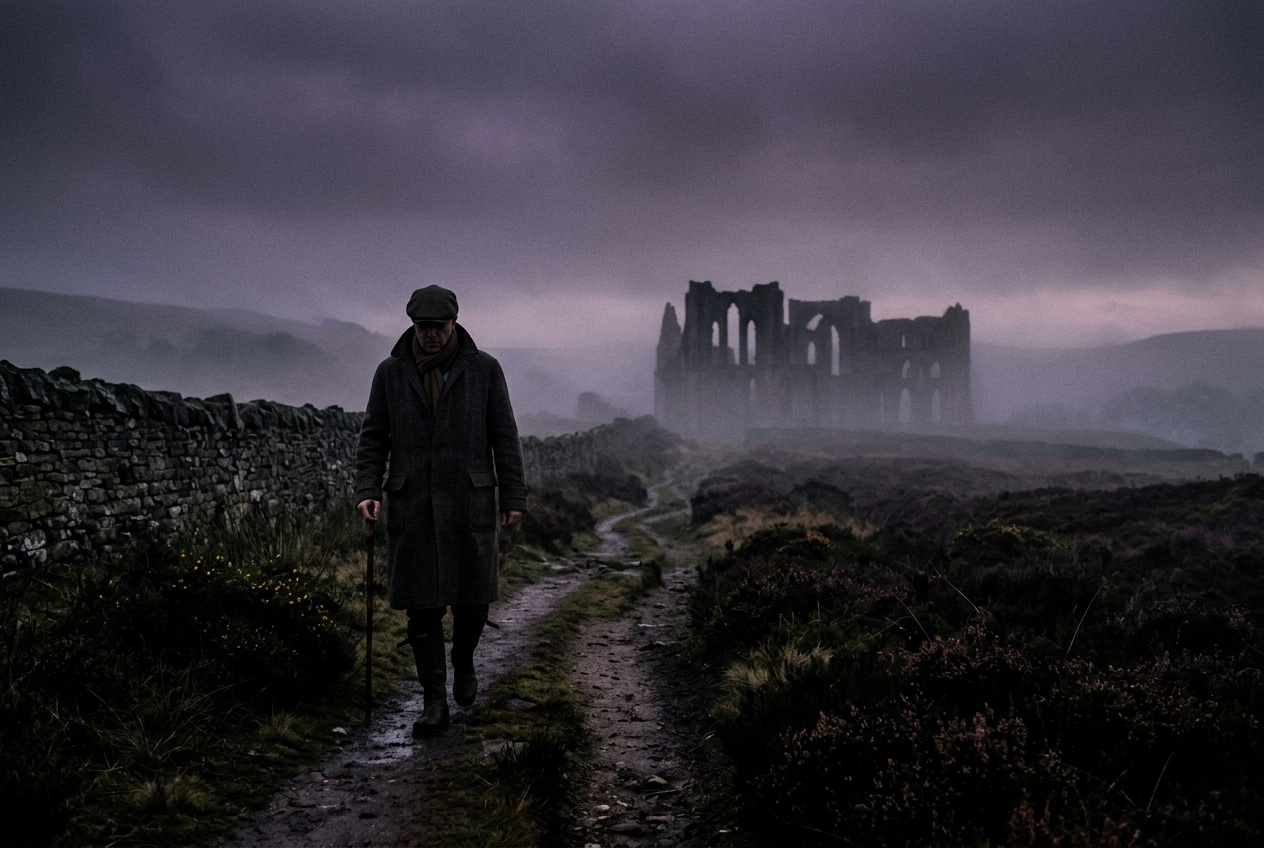
The fog had been in for three days.
Martin sat at the corner table with his pint. And his hands wrapped around it like it was the only warm thing left in the building. Pete came in, shut the door behind him, and stood there dripping.
—Shut it properly, said Martin.
Pete pushed the door again. The latch caught.
—Terrible out there, said Pete.
—It’s November.
—It’s not only November, Martin.
Pete sat down. He didn’t take his coat off. The pub was empty except for the two of them. And Linda behind the bar, who was wiping the same spot on the counter she’d been wiping for twenty minutes.
—Where’s everyone? said Pete.
—Gone home.
—It’s half seven.
—I know what time it is.
Pete looked at Linda. Linda looked at the counter.
—Right, said Pete. —So.
—So what?
—Don’t do that.
—Do what.
—The thing where you pretend you don’t know what I’m talking about.
Martin drank his pint. He put it down with care, like it might break.
—I saw it, said Pete.
—No you didn’t.
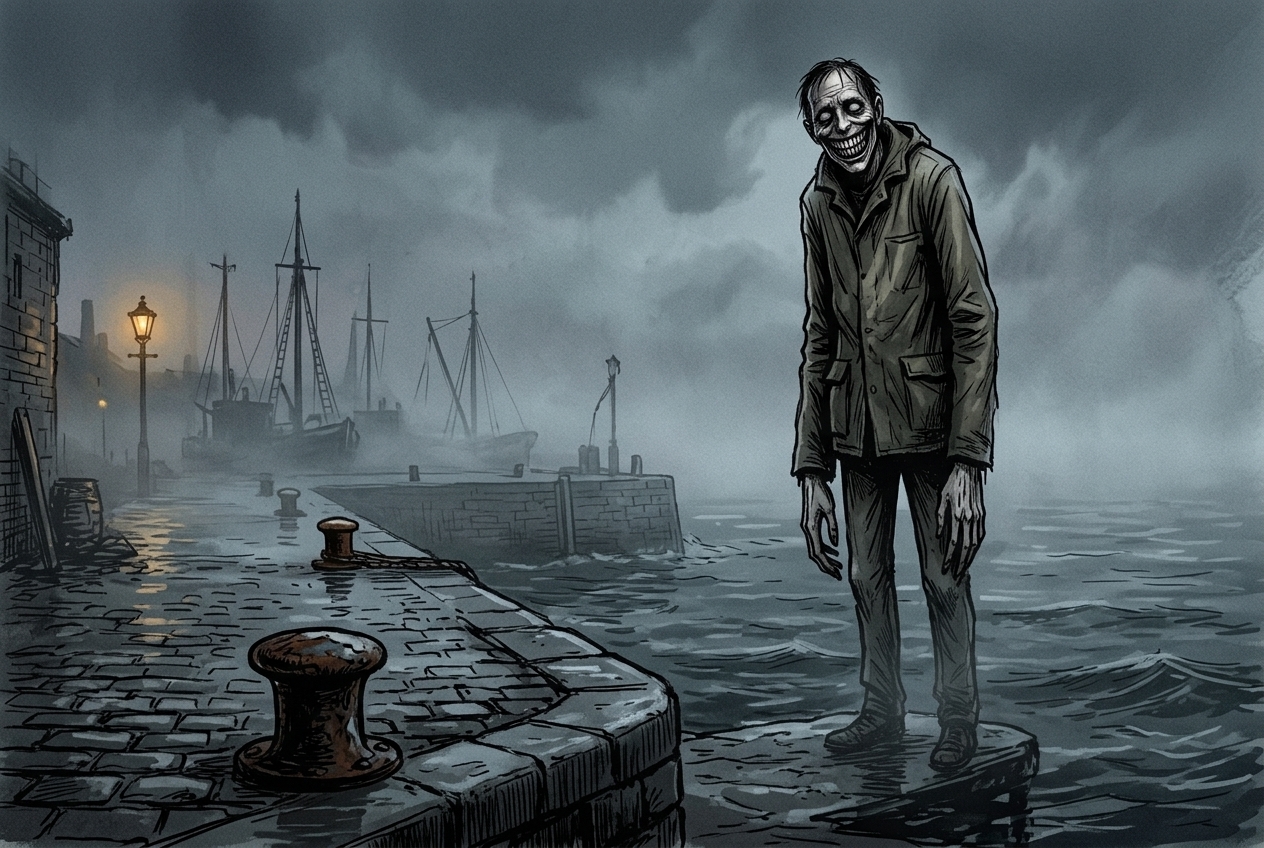
—On the harbour wall. Half past four. I was locking up the shed and I looked out and it was standing there.
—Standing where?
—On the edge. By the water. Standing there.
—Could’ve been anyone.
—It was seven feet tall, Martin.
—People are tall.
—Not that tall. And it was — wrong. The shape of it. Like someone had drawn a person and got the proportions off. The arms were too long. They hung down past its knees.
Martin said nothing.
—And the face, said Pete. —Jeez, the face.
—What about it.
—It was Dave’s face.
—Dave who.
—Dave Fletcher. From the chippy.
—Dave’s in hospital.
—I know he’s in hospital. That’s the point. I saw Dave last Tuesday before they took him in. He was yellow. He couldn’t walk proper. And this thing on the wall had his face but it was — smiling. Dave doesn’t smile like that. Nobody smiles like that.
Linda stopped wiping the counter.
—You should go home, Pete, she said.
—I’m not going home.
—Your wife. No point worrying her.
—My wife is at her sister’s in Worthing. She went yesterday. She said the kids were having bad dreams. Both of them. Same dream. A tall man at the window.
Martin finally looked at Pete. Stared at him. Pete’s face was white. Not cold-white. Scared-white.
—When did the fog start? said Martin.
—Monday.
—And when did Dave go into the hospital?
—Tuesday.
—And the kids’ dreams?
—Wednesday night.
Martin nodded. Slow, like he was adding something up and didn’t like the total.
—My dog won’t go outside, he said.
—What?
—My dog. Buster. He won’t go out the back. He sits at the door and whines. He pissed himself on the kitchen floor yesterday. He’s fourteen years old, Pete. He hasn’t done that since he was a pup.
—See, that’s what I’m saying.
—And the birds are gone.
—What birds?
—All of them. The gulls. The crows. The little ones on the feeder. Gone. Since yesterday morning. Not a sound. You notice that?
Pete hadn’t. But now that Martin said it he realised the silence was enormous. The kind of silence that pressed against the windows.
The door opened. Rachel came in. She was still in her nurse’s scrubs and she was shaking. Not shivering. Shaking.
—Lock the door, she said.
Linda came out from behind the bar and turned the lock.
—Rachel, love, sit down.
—I was at Dave’s house, said Rachel. —Checking on his mum. She’s on her own, isn’t she, with Dave in hospital.
—Is she alright? said Martin.
—She opened the door and she said, He’s home. I said, Who’s home? And she said, Dave. He came back. He’s in the kitchen.
Pete’s hands were flat on the table.
—And? he said.
—And I went into the kitchen. And there was something sitting at the table. It had Dave’s face. It was wearing Dave’s coat. The blue one with the zip. But it was too big for the coat. The sleeves didn’t reach its wrists. And it was eating. It had its hands in a loaf of bread and it was pulling it apart. Not eating it. Pulling it. And Dave’s mum was standing there smiling at it. She said, Isn’t it lovely having him back.
Rachel stopped talking. Her hands were in her lap. They were still shaking.
—Did you touch it? said Martin.
—No.
—Did it speak?
—No. It looked at me. It looked at me and it smiled and its teeth were — they weren’t teeth. They were too many. Too many teeth in a row. Like a shark. And the eyes were Dave’s eyes but there was nothing behind them. Like a house with the lights on and nobody home.
—Jesus, said Pete.
—I ran, said Rachel. —I bloody legged it. I left the door open. I left her in there with it.
—You couldn’t have stayed, said Linda.
—I know. I know I couldn’t. But I left her.
Nobody said anything for a while. The fog pressed against the windows. It was thick and grey and it didn’t move.
—It’s going door to door, said Martin.
—What?
—Think about it. The harbour. Dave’s house. It’s moving through the town. It’s looking for — I don’t know. Something. Someone.
—Or it’s arriving, said Pete. —One at a time. Taking people’s shapes. Walking into their houses.
The lights flickered. Once.
—Linda, said Martin. —Is the back door locked?
Linda looked at him.
—I don’t know, she said.
—Check it.
—Martin—
—Check it, Linda.
She went through the kitchen door. They heard her footsteps on the tile. They heard the handle turn.
They heard her scream.
It wasn’t a long scream. It was short and sharp and then it stopped, like someone had put a hand over her mouth.
Pete stood up. Martin grabbed his arm.
—Don’t, said Martin.
—She’s out there.
—I know.
—We can’t leave—
—I know.
The kitchen door was open. The fog was coming through it, rolling across the floor like something alive. And in the fog, at the edge of the light, there was a shape. Tall. Too tall. The arms hanging down.
It had Linda’s face.
It smiled.
Martin picked up his pint and finished it.
—Well, he said. —That’s that, then.